
- Derek Banker
- Dec 30, 2025
- 5 min read

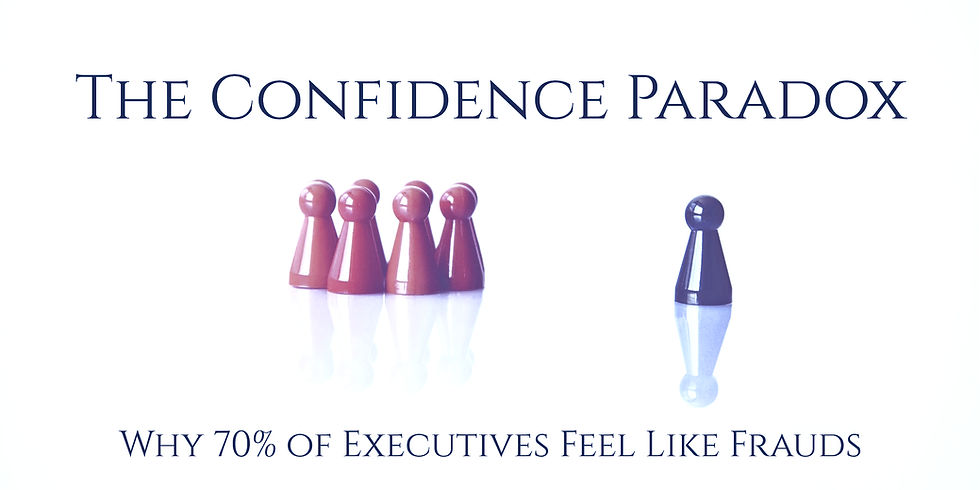
New data reveal that 70% of U.S. leaders experience impostor syndrome. Learn why this confidence gap exists and how organizations can close it.
We often operate under a false assumption regarding professional success. The general belief holds that as an individual climbs the corporate ladder, their confidence grows in lockstep with their titles and responsibilities. We assume that the CEO in the boardroom possesses an unshakable belief in their own competence.
Recent data dismantles this assumption entirely. Current research indicates that over 70% of professionals in the United States report experiencing "imposter syndrome." This phenomenon is not limited to entry-level employees learning the ropes. In fact, it is rampant at the very top, with 71% of CEOs admitting they frequently feel like frauds.
This is not simply a matter of personal insecurity. It represents a systemic risk to business operations. When the majority of a workforce questions their own legitimacy, decision-making slows, innovation stalls, and burnout accelerates. This article analyzes the root causes of this widespread crisis, examines how it manifests in daily business operations, and outlines specific strategies for organizations to mitigate its impact.
The Disconnect Between Achievement and Internal Reality
Imposter syndrome creates a psychological distortion where an individual cannot internalize their own success. Despite objective evidence of competence—revenue growth, successful project launches, or promotions—the individual attributes these wins to external factors like luck, timing, or the deception of others. They live in persistent fear that they will eventually be "found out."
The prevalence of this mindset among executives is particularly telling. High achievers are often the most susceptible because the higher they rise, the more they realize how much they do not know. Leadership roles today require navigating immense complexity without a clear playbook. When a leader faces ambiguous challenges and feels uncertain, they often interpret that uncertainty as incompetence rather than a natural reaction to a difficult situation.
This disconnect creates a silent friction within organizations. Leaders project certainty to their teams while harboring deep doubts internally. The energy required to maintain this façade drains cognitive resources that should be directed toward strategic thinking.
Why the Crisis is Accelerating

Several structural factors in the modern business environment fuel this crisis of confidence. It is not accidental that rates of self-doubt are climbing; the conditions of work have shifted in ways that undermine stability.
The Expectation of Instant Mastery
Business moves at an unprecedented velocity. Roles evolve rapidly, often requiring skills that did not exist five years ago. Consequently, leaders are frequently placed in positions where they must learn in real-time. Corporate culture, however, often retains an archaic expectation of instant mastery. When leaders feel they must know everything immediately, any gap in knowledge is interpreted as a personal failure rather than a necessary learning curve.
The Visibility Trap
Digital connectivity has increased the visibility of leadership. Executives operate under constant scrutiny, where every decision can be publicly analyzed and critiqued. This hyper-visibility raises the stakes of every error. The pressure to appear flawless in a public forum creates a defensive posture, where admitting to uncertainty feels like a career-ending vulnerability.
Systemic Bias and Isolation
For women and minority executives, the feeling of being an outsider is often reinforced by structural realities. When a leader looks around the boardroom and sees no one else who shares their background, the internal narrative that they do not belong is externally validated. This lack of representation forces these leaders to expend additional energy proving their right to occupy the seat, exacerbating feelings of fraudulence.
Identifying the Manifestations in Business
Imposter syndrome is rarely expressed openly. Instead, it manifests through specific behavioral patterns that can damage organizational efficiency. Recognizing these behaviors is the first step toward addressing the underlying issue.
Paralysis Through Perfectionism
The most common manifestation is a debilitating need for perfection. A leader who feels like a fraud may obsess over minor details to avoid any possibility of criticism. This results in micromanagement, as they do not trust their team to execute to their impossible standards. Decision-making bottlenecks form because the leader is terrified of making the wrong call.
The Cycle of Overworking
Many executives compensate for their perceived inadequacy with sheer volume of effort. They operate under the belief that if they work harder than everyone else, no one will notice their supposed lack of talent. This leads to the "superhuman" complex, where leaders burn the candle at both ends. While this may yield short-term results, it inevitably leads to burnout and sets an unsustainable precedent for their teams.
Risk Aversion and Silence
A leader plagued by self-doubt will often avoid taking calculated risks. They stick to safe, established paths to avoid the potential exposure that comes with failure. In meetings, they may withhold valuable dissenting opinions or innovative ideas because they fear their input will reveal their incompetence. This silence deprives the organization of critical diverse perspectives.
Critical Trigger Points
Self-doubt is not a constant state; it surges during specific professional transitions. Organizations must be aware of these trigger points to provide adequate support.
The Promotion Paradox
The moment of promotion is often the peak of imposter syndrome. The skills that got an individual to a certain level are rarely the skills needed for the next. A top-performing sales director who becomes a VP of Sales moves from execution to strategy. In this gap between old competence and new requirements, the feeling of fraudulence thrives.
Crisis Management
Periods of external instability—economic downturns, public relations crises, or massive industry shifts—strip away the illusion of control. Leaders are expected to steer the ship through storms they have never encountered. The pressure to provide answers when none exist can trigger intense feelings of inadequacy.
Performance Reviews and Feedback
Even positive feedback can trigger imposter feelings if the recipient believes they fooled the reviewer. Constructive criticism, meanwhile, is often internalized not as feedback on a specific task, but as confirmation of their total incompetence.
Strategies for Organizational Resilience

Addressing imposter syndrome is a governance issue. Companies must build cultures that value resilience and learning over the illusion of perfection.
Reframe Competence
Organizations must redefine what it means to be competent. Competence should not be defined as having all the answers, but as the ability to find them. Leaders should be evaluated on their resourcefulness, adaptability, and ability to learn, rather than their static knowledge base. This shift allows executives to admit what they do not know without fear of retribution.
Normalize Uncertainty
Senior leadership must model vulnerability. When a CEO stands before the company and admits that a problem is difficult and the solution is not yet clear, it grants permission for others to be honest about their own challenges. This transparency reduces the pressure to maintain a façade and fosters a culture of collaborative problem-solving.
Institutionalize Mentorship
Mentorship should not be reserved for junior employees. Senior executives benefit immensely from peer groups and coaching where they can discuss their doubts openly. Creating safe spaces for leaders to share their struggles normalizes the experience and breaks the isolation that feeds imposter syndrome.
Focus on Data-Driven Feedback
Imposter syndrome thrives on subjective feelings. Organizations can combat this by grounding performance evaluations in objective data. When success is measured by clear, quantifiable metrics, it becomes harder for an individual to attribute their achievements to luck. Regular, fact-based affirmations of value help align internal self-perception with external reality.
Conclusion
The high prevalence of imposter syndrome in U.S. businesses reveals a fundamental flaw in how we view leadership. We have constructed an ideal of the leader as an stoic, all-knowing entity, an ideal that is impossible to meet in a complex world.
The goal is not to eliminate doubt entirely, as a degree of self-questioning prevents arrogance and encourages preparation. The objective is to prevent doubt from becoming a barrier to action.
By acknowledging that feelings of inadequacy are a common companion to high achievement, organizations can empower their leaders to operate with authenticity. When leaders stop wasting energy hiding their perceived flaws, they can redirect that energy toward driving genuine innovation and growth.

$50
Product Title
Product Details goes here with the simple product description and more information can be seen by clicking the see more button. Product Details goes here with the simple product description and more information can be seen by clicking the see more button

$50
Product Title
Product Details goes here with the simple product description and more information can be seen by clicking the see more button. Product Details goes here with the simple product description and more information can be seen by clicking the see more button.
$50
Product Title
Product Details goes here with the simple product description and more information can be seen by clicking the see more button. Product Details goes here with the simple product description and more information can be seen by clicking the see more button.


Comments